




































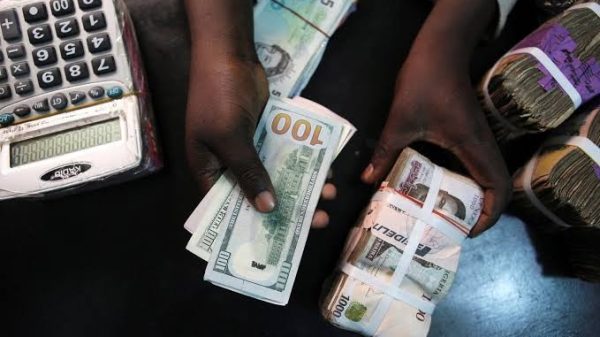



The Nigerian Naira came under renewed pressure in the foreign exchange market on Tuesday, March 24, 2026. This latest dip in value across both official and parallel market segments appears to be triggered by a sudden surge in demand for the United States Dollar.
Data monitored by Zoyols News from the Nigerian Foreign Exchange Market (NFEM) shows that the Naira weakened by approximately 2.48 percent during the early hours of Tuesday’s trading session. The Dollar opened at an average of ₦1,388.38, marking a decline from the ₦1,353.90 recorded at the close of the previous week. Despite the stability recently introduced by the Central Bank of Nigeria’s Electronic Foreign Exchange Matching System, the market experienced notable intraday volatility, with rates hitting ₦1,395.00 before seeing a slight moderation.
Financial analysts suggest this spike is likely tied to a combination of end-of-quarter corporate needs and a temporary lull in autonomous inflows. This downward trend was mirrored in the informal market, where speculative activity has begun to resurface. In major trading hubs across Lagos, Kano, and Abuja, bureau de change operators were quoting the Dollar between ₦1,415 and ₦1,425 for selling, a jump from the ₦1,400 rate seen earlier in the week.
One interesting development in today’s trading is the narrowing gap between official and parallel market rates, which now stands at roughly ₦27. While this convergence is a goal of the current unification reforms, the narrowing seen today was primarily due to the official rate climbing toward the street price rather than an actual appreciation of the local currency.
This market volatility arrives at a time when Nigeria’s external reserves are seeing a slight dip. After hitting a 13-year peak of $50.45 billion in February, the figures from the apex bank indicate a moderation to $49.78 billion as of mid-March. This shift is being attributed to sustained outflows and heightened geopolitical tensions in the Middle East, which continue to influence global financial movements.
Even with global oil prices remaining favorable—with Bonny Light trading above the $100 mark—internal production hurdles and existing crude-backed obligations are limiting how quickly these high prices translate into liquid foreign exchange for the country.
The Central Bank remains firm in its stance on monetary tightening to keep inflation on its downward path, which recently eased to 15.06 percent. Traders and investors are now looking toward the apex bank’s next move, as further intervention may be necessary to stabilize the Naira and maintain the narrow spread between market segments as the week progresses.