

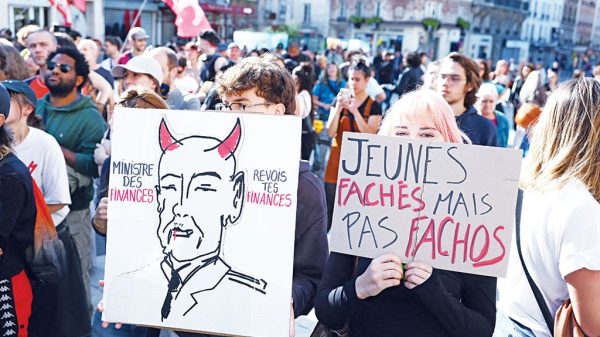


























Up to 500 secondary schools across France are expected to close fully or partially as a growing wave of student protests continues to disrupt the country.
Education Minister Edouard Geffray said about 400 to 500 high schools would suspend classes to some extent because security conditions had not been met. He said 24 schools had already been burned or seriously damaged since the protests began.
The closures are largely being treated as a security measure ahead of larger demonstrations planned by protest organisers for Tuesday.
French high school students, known as lycée students, have raised concerns about teacher shortages, lengthy school days, poor classroom conditions and ageing facilities. Many students argue that these problems are affecting the quality of their education.
Geffray said Monday’s disruption was expected to be similar to the previous Friday, but maintained that schools would gradually return to normal operations as security conditions improved.
The protests began on September 17 at a school in the Paris suburb of Créteil before spreading to other parts of France. Demonstrations have since become increasingly tense, with some clashes between students and security forces resulting in the use of tear gas and batons.
The education minister accused activists, particularly those associated with the far left, of taking advantage of the student movement and contributing to the violence. He said the unrest had created risks for both students and education workers.
According to Geffray, 78 education staff members have been injured during the protests, a situation he described as unprecedented. He also alleged that some teachers were deliberately targeted because they worked for the national education system.
Protest organisers have called for the demonstrations to continue on Tuesday, arguing that the government has yet to offer sufficient concrete measures to address the students’ concerns.
More than 5,000 people have reportedly been arrested since the movement began, with about 85 per cent of those detained being minors.
The police response has also come under criticism. Amnesty International’s France branch accused security forces of using disproportionate tactics and called for students to be allowed to express their concerns without being subjected to excessive force or unnecessary detention.
Interior Minister Laurent Nunez rejected the criticism, saying security forces were not targeting young people but were protecting students who wanted to peacefully express their demands.
Tensions have also been heightened by several violent incidents. A 16 year old was detained in connection with an attack on a 59 year old teacher in La Ciotat. The teacher was reportedly doused with gasoline and struck during a student protest.
In another incident in Belfort, eastern France, youths were filmed attacking a police officer who had fallen to the ground. Two Bulgarian teenagers, aged 15 and 17, were arrested and placed under investigation over the alleged assault.
The protests have been driven largely by concerns about the state of France’s education system. Students have complained about teacher absences, overcrowded schedules and long school days that can run from around 8am until 6pm.
French sociologist Valerie Becquet said students, particularly those from poorer communities, increasingly feel that they are receiving an inferior standard of education.
The movement began at the Saint Exupéry high school in Créteil, where students initially demonstrated in support of teachers protesting staff shortages and inadequate resources. The situation at the school later improved after education authorities agreed to provide additional personnel, including a deputy principal and a nurse.
Social media has also played an important role in spreading the protests. Students have recorded scenes of burning rubbish bins, confrontations and police operations, with dramatic footage quickly circulating on platforms such as TikTok.
The unrest has also exposed longstanding inequalities within France’s education system. Although access to lycée education is available to students across the country, there are major differences between vocational schools and elite institutions.
Becquet noted that prestigious schools continue to attract a large number of students from wealthy families with university educated parents, despite efforts to improve diversity.
The protests have also become a political issue as France moves closer to its presidential election. The government has accused the hard left France Unbowed movement of helping to drive the demonstrations, an allegation senior party official Manuel Bompard rejected as a descent into conspiracy theories.
Veteran France Unbowed politician Jean Luc Mélenchon has expressed strong support for the students while urging protesters to avoid violence.
Meanwhile, the increasingly forceful response from security agencies has added another layer to the crisis. Demonstrators have blocked school entrances, burned objects and thrown projectiles, while police have responded with tear gas, rubber bullets and batons in some locations.
After clashes between students and police in Tours, one young protester reportedly suffered an injury that resulted in the loss of sight in his right eye, according to the city’s prosecutor.
Videos showing alleged excessive use of force by police have also spread widely online, further increasing tensions between protesters and authorities.
With more demonstrations expected, the French government now faces growing pressure to address the students’ complaints while preventing further violence and keeping schools safe for students and staff.