


























Protests against President Felix Tshisekedi’s proposed constitutional changes turned violent in parts of the Democratic Republic of Congo on Tuesday, with police using tear gas and making arrests as opposition supporters took to the streets.
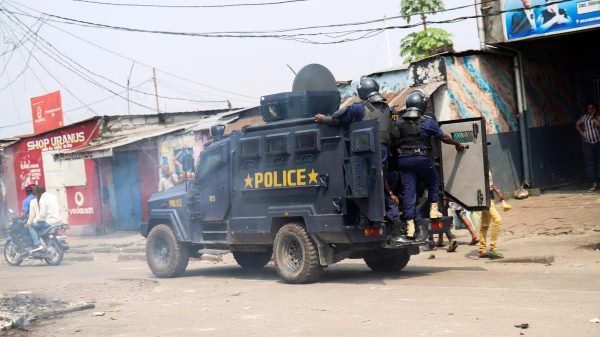
In Kinshasa, demonstrators and pro government supporters clashed shortly after an opposition led march got underway. Riot police were deployed across the capital, particularly along the planned route and at major intersections, before intervening with tear gas to break up the confrontation. At least two protesters were reportedly injured.
The nationwide demonstrations were organised by the C64 coalition, an alliance of opposition forces that has been campaigning against efforts to amend the constitution. Opposition parties have increasingly joined forces over concerns that the proposed changes could allow Tshisekedi to seek a third term.
Hundreds of protesters gathered in Kinshasa carrying flags after the coalition called for a nationwide day of action. Although traffic remained relatively light in the capital, tensions quickly rose once the march began.
Tshisekedi first became president in 2019 and secured a second term in 2023. His victories left the opposition facing a weakened political position.
A senior C64 figure had previously called on the president to abandon efforts to alter the constitutional two term limit. The proposed changes have received backing from a parliament dominated by the ruling party, even as the country continues to deal with serious insecurity, particularly in the east.
The eastern region has been affected by prolonged fighting, including the advance of the Rwanda backed M23 armed group, which captured large areas of territory last year.
The opposition coalition also rejected Tshisekedi’s offer of a national dialogue last month. C64 leaders accused the president of seeking to use the process to strengthen his political position and instead opted to proceed with the planned protests.
In Lubumbashi, a major mining city in the southeast, activists gathered in defiance of a protest ban imposed by local authorities. Police later moved to disperse the crowd using tear gas and warning shots, with several people arrested.
Mohamed Eyenga, provincial coordinator of the Envol opposition party and a senior C64 figure, said the protesters had gathered for a peaceful demonstration and alleged that several activists had been arrested arbitrarily.
“Many of our activists were unfortunately and arbitrarily arrested,” he said.
Provincial police commander General Blaise Kilimbalimba disputed the claim, saying that no peaceful demonstrator had been arrested. He said security personnel had been deployed to ensure citizens could continue their activities freely and maintained that the situation had remained calm.
Further protests were reported in Mbandaka, the capital of northwestern Equateur province, where authorities had also prohibited demonstrations.
About 100 activists gathered in the city before security personnel moved in to disperse them. An AFP journalist at the scene reported that officers were carrying weapons and that about 10 people were arrested.
The heavy presence of security personnel drew concern among protesters, with one activist describing the deployment of soldiers and police as unexpected.