


























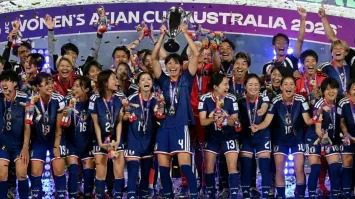
Japan has solidified its status as the premier force in Asian women’s football after a hard-fought victory over Australia to claim their third Women’s Asian Cup title. In a repeat of the 2014 and 2018 finals, the Japanese side secured a 1-0 win on Saturday night, breaking the hearts of a record-breaking home crowd in Sydney.
The decisive moment came early in the match when Tottenham star Maika Hamano produced a moment of individual brilliance in the 17th minute. Collecting the ball well outside the area at Stadium Australia, Hamano unleashed a stunning 25-yard strike that flew into the top corner, leaving the Australian defense stunned. It was a goal worthy of a championship decider and one that ultimately separated the two continental giants.
The tournament has been a landmark event for the growth of the women’s game. Over 350,000 fans attended matches throughout the competition—nearly six times the previous record set in 2010. The final itself saw 74,397 spectators pack the stands, setting a new historical benchmark for a single game in the tournament’s history.
Beyond the trophy, the competition served as a vital path to the World Cup in Brazil next year. Along with finalists Japan and Australia, South Korea, China, North Korea, and the Philippines have all successfully secured their spots on the world stage.
Japan’s journey to the trophy was nothing short of dominant. Bolstered by several stars playing in the English top flight, the team scored a staggering 29 goals while conceding only once across six matches. Their Greenlander coach, Nils Nielsen, admitted after the final whistle that the game was a 50-50 battle, praising Australia for a performance they should be proud of while expressing immense relief that his players fought until the very end.
For the hosts, it was a night of missed opportunities. Arsenal striker Caitlin Foord had a clear chance to open the scoring in the 11th minute after a clever pass from Mary Fowler, but her shot went straight to the Japanese keeper. Foord had further chances before the break, and a late surge in the 88th minute by Alanna Kennedy nearly forced an equalizer, but the Japanese defense remained disciplined and absorbed the intense pressure.
Australia’s coach, Joe Montemurro, reflected on the narrow loss with visible disappointment, noting that his team competed head-to-head with the sixth-ranked side in the world. Despite the dejection of the home fans, the tournament served as a powerful statement for the future of the sport in the region, even if the night ultimately belonged to the technical brilliance of the Japanese squad.