
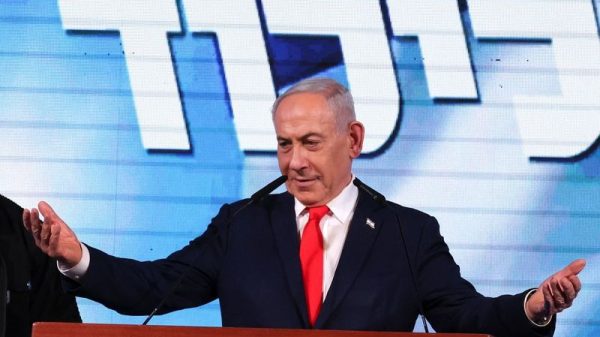

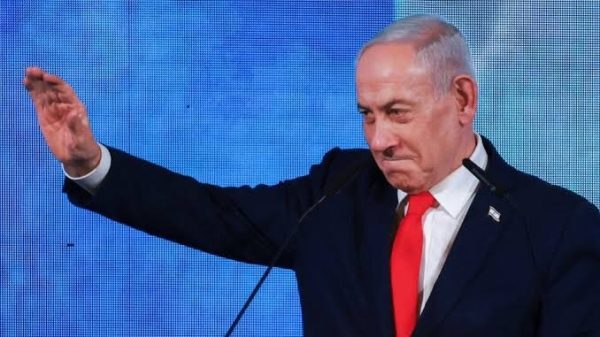
























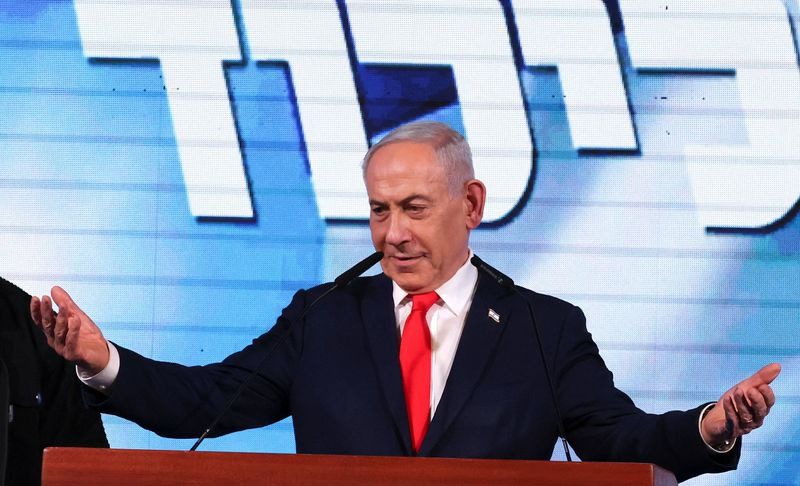
The closely watched vote, held on Tuesday, recorded the highest voter turnout in decades and was widely seen as a judgment on Netanyahu’s leadership. The long-serving prime minister has been in power for more than 19 years across different periods, making him one of the most influential and enduring figures in Israeli politics.
With almost all the ballots counted, Netanyahu’s right-wing alliance appeared to have a narrow lead over the opposition camp led by former military chief Gadi Eisenkot. However, neither side had secured enough seats to command a parliamentary majority, leaving the country facing another difficult round of coalition negotiations.
Both political camps have indicated their intention to form the next government. The process could take weeks, and the uncertainty may work in Netanyahu’s favour for now, as he remains in office in a caretaker capacity until a new administration is formed.
Arab political parties, which made significant gains in the election, could emerge as decisive players. Their support may help the opposition remove Netanyahu from power, provided Eisenkot’s camp is willing to work with them.
However, Netanyahu has repeatedly attacked Arab parties during his campaign and has now accused them of interfering with the election. He has also called for an investigation into allegations of foreign funding, although no evidence has been presented to support the claims.
President Isaac Herzog, who is responsible for selecting a candidate to form the next government, has urged political leaders to avoid another election. His position has renewed discussions about the possibility of a national unity government involving rival political groups.
Netanyahu appeared particularly concerned about voter turnout during the final hours of the campaign. He made a last-minute appeal to supporters in a Likud stronghold, urging them to abandon their personal activities and head to polling stations.
“We cannot leave this battle here in the hands of the left and the Arab parties,” he told the crowd, before encouraging them to vote for Likud rather than spend the day at the beach or holding barbecues.
The election came at a difficult time for Netanyahu, whose long-standing reputation as a leader capable of protecting Israel’s security was severely damaged by Hamas’s October 7, 2023 attack. Eisenkot used public anger over the security failure to challenge the prime minister’s leadership.
Netanyahu, however, made an aggressive effort to regain public confidence. He highlighted his close relationship with US President Donald Trump and pointed to Israeli military operations against Hamas in Gaza, Hezbollah in Lebanon and Iran, which has supported the armed groups.
At 77, Netanyahu faces several major challenges beyond the election result. They include an international arrest warrant over alleged war crimes in Gaza, an ongoing corruption trial and a prolonged conflict involving several fronts.
A political career shaped by ideology and ambition
Born in Tel Aviv on October 21, 1949, Netanyahu grew up in a family with strong nationalist views. His father, Benzion Netanyahu, was associated with the Revisionist Zionist movement led by Zeev Jabotinsky, which promoted the idea of a Greater Israel.
Those political influences helped shape Netanyahu’s position on the Israeli-Palestinian conflict. He opposed the peace process of the 1990s, which sought to establish a two-state solution, and played a major role in weakening efforts to reach an agreement.
Netanyahu has consistently rejected the creation of a Palestinian state. He has also supported the annexation of parts of the occupied West Bank and policies that encourage the expansion of Israeli settlements, which are considered illegal under international law.
Before entering politics, he served in an Israeli commando unit and took part in the 1973 Arab-Israeli war. One of the most painful events in his life was the death of his older brother, Yonatan, who was killed while leading the Israeli hostage rescue operation at Entebbe Airport in Uganda.
Netanyahu later described the moment he received the news as a devastating personal loss, writing that he felt as though his life had ended.
Having spent part of his childhood in the United States, he became comfortable communicating with international audiences, particularly in the American media. He graduated from the Massachusetts Institute of Technology and developed a reputation as one of Israel’s most effective public representatives abroad.
His political career advanced rapidly after he was elected to the Israeli parliament in 1988. Five years later, he became leader of the right-wing Likud party.
In 1996, Netanyahu secured an unexpected election victory against the backdrop of the assassination of Prime Minister Yitzhak Rabin, who had been involved in peace negotiations with the Palestinians. At 46, he became the youngest prime minister in Israel’s history.
He served from 1996 to 1999 before returning to power in 2009. His second period in office lasted until 2021, after which he returned as prime minister in late 2022 through an alliance with several right-wing and far-right parties, including groups that had previously been politically isolated.
Netanyahu’s influence on the Middle East
For much of his political career, Netanyahu has argued that Israel’s security depends primarily on maintaining overwhelming military strength. Despite his firm positions, he was also known for exercising caution in dealing with some regional threats.
His opposition to Palestinian statehood influenced his approach to Gaza. Netanyahu viewed Hamas’s control of the territory as a means of keeping Palestinian political leadership divided and limiting the influence of the Palestinian Authority, which governs parts of the occupied West Bank and enjoys considerable international support. Qatar also provided financial assistance to Gaza during Hamas’s rule.
However, the October 7 attack exposed serious weaknesses in Israel’s security strategy and raised questions about the decisions made under his leadership.
As the war expanded, Netanyahu increasingly presented Israel’s military campaign as a long-term struggle against Iran’s regional influence. He argued that the conflict was necessary to transform the Middle East and weaken the power of Iran’s clerical leadership.
In recent months, he has repeatedly claimed that his policies have changed the face of the region.
Supporters believe Netanyahu has shown determination in responding to the October 7 attack and confronting Iran directly, a step they argue previous Israeli leaders had avoided.
His critics, however, say his decisions have prolonged regional conflicts, increased Israel’s international isolation and left the country facing serious security and diplomatic challenges.
The possibility of renewed hostilities with Iran has also added pressure to discussions about a national unity government. Such an arrangement could bring Netanyahu and Eisenkot’s political camps together, although the former military chief has previously insisted that Netanyahu is no longer fit to remain in office.
With neither side securing a decisive election victory, Netanyahu’s political future now depends on his ability to negotiate new alliances and maintain enough support to remain in power.







