
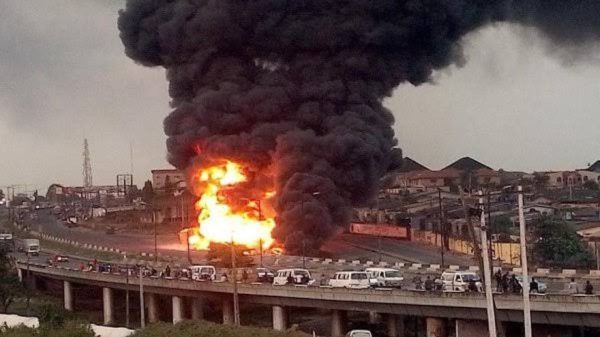






































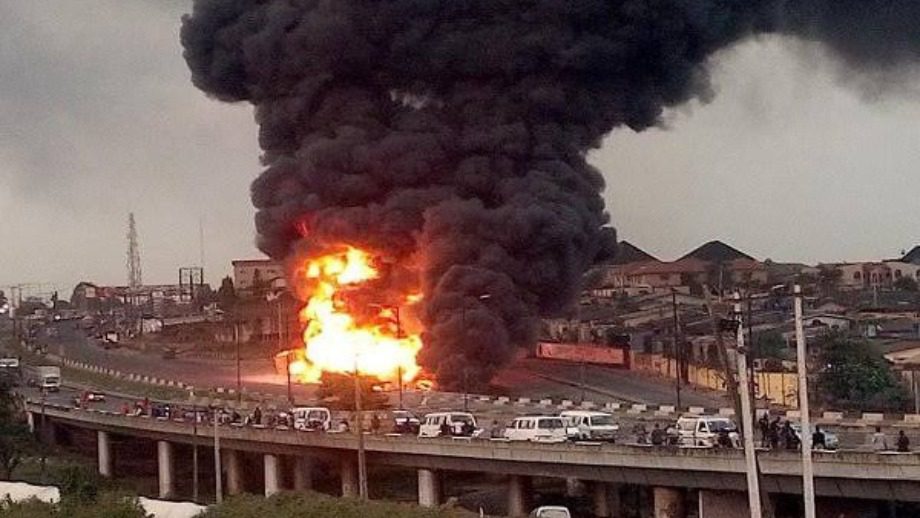
The Federal Road Safety Corps has ordered a full-scale investigation into the tanker explosion that rocked the Otedola Bridge axis of Lagos, leaving commuters shaken and traffic heavily disrupted.
The incident unfolded on Monday afternoon when a diesel-laden tanker lost control, careened off the highway, and plunged into the underpass beneath the bridge along the outward section of the expressway. The crash triggered an intense inferno that sent thick plumes of smoke billowing into the sky, drawing immediate attention from emergency responders and motorists alike.
Preliminary reports from the Lagos Sector Command indicate that excessive speed was the primary catalyst for the disaster. While the raging fire caused significant panic and property damage, initial assessments confirmed a stroke of fortune regarding human life: no fatalities were recorded at the scene. Two adult male occupants sustained varying degrees of injuries and were promptly rushed to the Lagos State Accident and Emergency Centre for urgent medical care.
Emergency teams mobilized with remarkable speed. Field operatives arrived at the scene shortly after the distress call went out, joining forces with the Lagos State Fire and Rescue Service, the Lagos State Traffic Management Authority, and the Nigeria Police Force to battle the blaze, clear the wreckage, and restore a semblance of order to the gridlocked corridor.
Reacting to the development, Corps Marshal Shehu Mohammed expressed grave concern over the recurring menace of reckless driving, particularly among operators of heavy-duty vehicles conveying hazardous materials. He noted that the disaster serves as a stark reminder of how easily negligence on public infrastructure can jeopardize innocent lives on a massive scale.
The Corps Marshal maintained that moving petroleum products demands exceptional professional discipline, rigorous vehicle maintenance, and uncompromising adherence to safety protocols. He warned fleet owners and transport companies against prioritizing profit margins and tight delivery schedules over human lives, stressing that poor supervision and mechanical neglect are entirely inexcusable.
Beyond the immediate aftermath, authorities have renewed calls for stricter oversight, comprehensive driver training, and absolute compliance with speed limits across all major highways. At the same time, the agency issued a stern caution to onlookers and scavengers who routinely rush toward accident scenes to collect spilled fuel or capture footage, emphasizing that such perilous curiosity often invites fatal consequences and hampers the lifesaving work of first responders.







