






































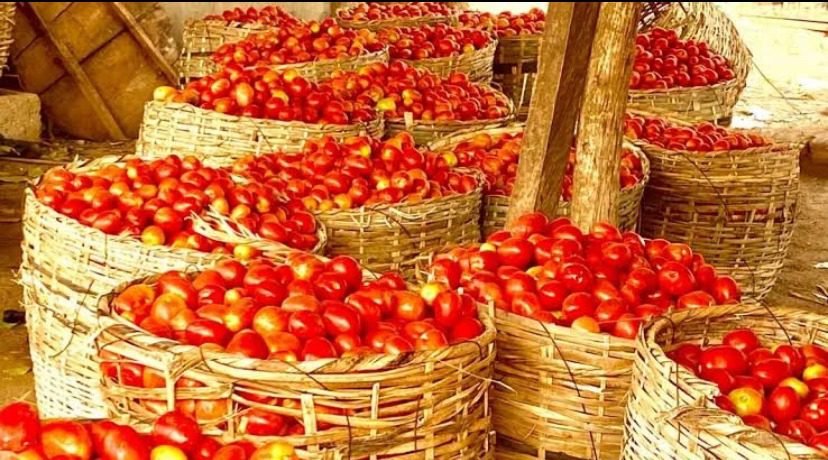
Housewives, caterers and tomato consumers across the country are groaning under the weight of rising tomato prices, with many saying the spike has forced them to cut back on purchases, alter recipes and absorb painful losses in household and business budgets.
The worsening instability in tomato prices is also adding pressure to food inflation, as consumers and traders struggle to keep up with the sharp rise in the cost of one of the country’s most widely used food items.
Farmers and market players, however, say the problem goes beyond seasonal scarcity. They blame the collapse of industrial off take arrangements and the reduced presence of major tomato processing companies for worsening losses across the value chain. According to them, the absence of large scale buyers has weakened confidence among farmers, discouraged production and made the market more unstable.
Although Nigeria remains Africa’s second largest producer of tomatoes after Egypt, with annual output estimated at between 1.8 million and 2.3 million metric tonnes, the commodity continues to play a major role in rising food costs. Data from the National Bureau of Statistics showed that food inflation climbed to 16.96 per cent in May 2026, up from 16.68 per cent in April.
Findings by Zoyols News at Mile 12 International Market in Lagos showed just how sharply prices have risen in recent weeks. A large basket of Jos tomatoes that sold for between N60,000 and N70,000 in May now goes for between N120,000 and N150,000. The price of a crate has also jumped from around N25,000 to N70,000 in the space of about three weeks.
The survey also showed that cheaper South West tomato varieties have become more common in the market, but many buyers and retailers say they are not as productive in cooking because they contain more water and yield less paste than northern tomatoes.
A foodstuff trader, Madam Jerome, said buyers are now purchasing tomatoes strictly out of necessity.
“I bought a basket equivalent to three paint containers for N40,000. Many people like this one because of the colour and plumpness, but tomatoes are like gold in the market now,” she said.
Another buyer, Blessing, said her family still prefers tomatoes from the North because they produce a thicker paste. Madam Jerome also recounted how she lost money after paying N120,000 for a basket of Jos tomatoes, only to discover that many of those hidden underneath were unripe and partly spoilt.
A tomato seller, Ibrahim Aminu, linked the rising prices to poor farming conditions in the North, saying rainfall and drought have affected cultivation and output.
For many households, the impact is already being felt in the kitchen. Mrs Susan said tomatoes have almost disappeared from her weekly meals because of the current prices.
“Normally, I buy a paint of tomatoes for N3,500, but recently I got one for N15,000. We now make more vegetable sauce, carrot and cabbage sauce, and even palm kernel stew. The last vegetable sauce I made was very dark because I used very little tomato,” she said.
Another consumer, Mrs Ebele, said the paint bucket she used to buy for N4,000 now sells for N10,000 in her area. To cope, she now buys smaller quantities and combines them with vegetables so the food can still go round her family.
Caterers are also counting their losses. Mrs Princess said she was badly hit after tomato prices rose from about N70,000 to N150,000 per basket shortly before an event she had already priced.
“I regretted collecting full payment before the event. I lost a lot of money and even had to settle workers from my own pocket,” she said.
Another caterer, Juliet, said many operators now reduce the quantity of fresh tomatoes used in meals or mix them with tomato paste in a bid to manage costs and protect what is left of their profit.
The pressure is not limited to tomatoes alone. A pepper trader, Murtala, said weather challenges in the North have also pushed up pepper prices and may soon lead to scarcity of northern pepper in the market. He said a medium sized bowl of pepper and shombo now sells for about N30,000, while tatashi goes for as much as N40,000.
A ginger trader, Mustapha, also said the price of ginger has surged sharply, with a sack now selling for N700,000 compared with about N200,000 previously.
Reacting to the situation, the National Secretary of the National Tomato Growers, Processors and Marketers Association of Nigeria, Sani Danladi Yadakwari, described the development as a seasonal supply crisis made worse by insecurity and the absence of major industrial buyers.
“Three days back, even at the farm gate, a crate was going for almost N50,000. There is simply no tomato available right now. Almost all of it has finished,” he said.
According to him, only two major tomato processing companies are still actively buying from farmers, while others such as Dangote Tomato Processing Company, GBFoods and Savannah Integrated Farm have either cut back operations or stopped taking tomatoes altogether.
He said the lack of a dependable off taker system has made tomato farming a risky investment for many producers.
“There is no guaranteed off taker system for fresh tomatoes in Nigeria. Because there are no reliable buyers, farmers are afraid to invest heavily in production,” he said.
Danladi Yadakwari explained that when harvest season arrives, tomatoes often flood the market because there are not enough processors to absorb the excess, leaving farmers and traders with huge losses. He added that insecurity in farming communities is making matters worse, warning that next year could be even more difficult if the situation does not improve.
“Most people in the farming areas are dealing with insecurity. Many have already abandoned their farms and that will definitely affect prices next year. I do not think it will be any better,” he said.
He also pointed to climate change, high production costs and the destructive Tuta absoluta pest as some of the major threats to tomato farming in the country. According to him, extreme heat is now affecting seed performance, with seeds that should germinate in about 21 days taking nearly 40 days.
Despite the current pressure, he expressed hope that supply would improve from August when rainy season harvests begin to reach the markets.
Also speaking on the challenge, the Secretary of the Tomato Section of Mile 12 International Market Association, Sulaiman Adawa, acknowledged that the disappearance of major processors has remained a major setback for the sector.
“In the past, some companies bought tomatoes from farmers in large quantities, but many of them have stopped. Maybe they felt it was no longer profitable,” he said.
As a way out of the crisis, NATPAN is urging farmers to embrace greenhouse farming while calling on the government to support production with solar powered irrigation systems. Danladi Yadakwari said reducing dependence on fuel powered generators would cut production costs and encourage year round cultivation.
“If farmers use solar energy instead of fuel powered generators, production costs will reduce significantly. That will encourage more farmers to return to production,” he said.