














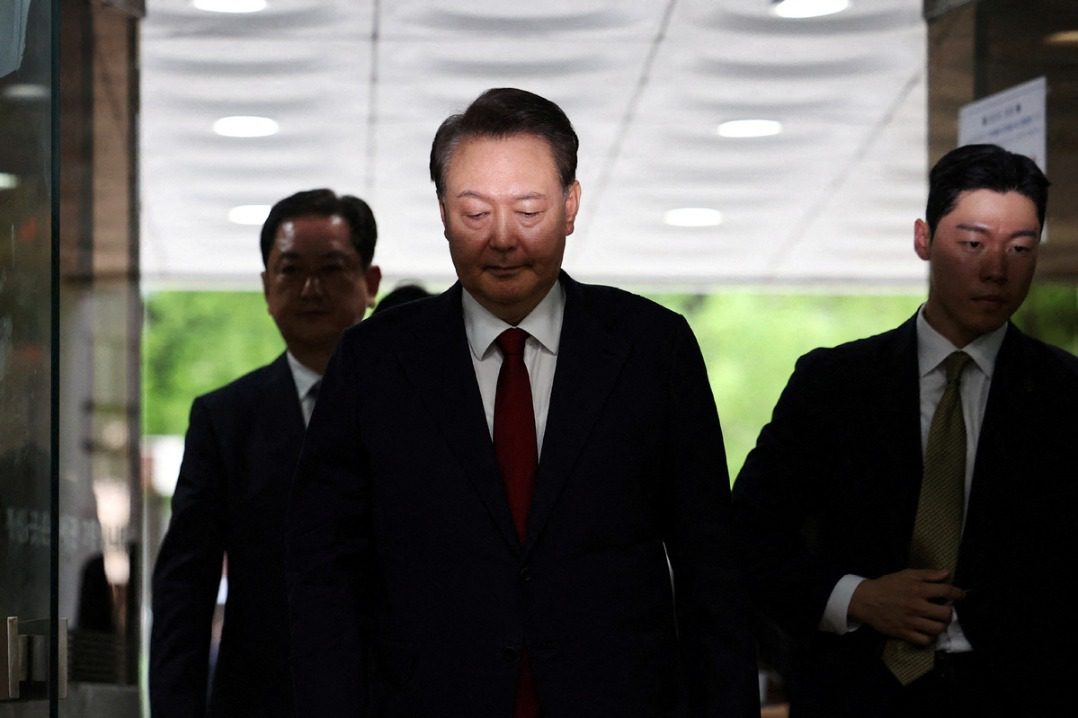
South Korea’s Supreme Court has upheld the seven year prison sentence handed to former president Yoon Suk Yeol over offences linked to his failed 2024 martial law declaration and the turmoil that followed.
The ruling, delivered on Thursday, marks another major legal blow for the disgraced ex leader, who is already behind bars while challenging a separate life sentence tied to insurrection charges stemming from the same martial law episode.
The case before the country’s highest court centred on allegations that Yoon interfered with cabinet deliberations in the lead up to the declaration, used forged signatures belonging to the prime minister, and later deployed presidential security personnel to block his own arrest after lawmakers moved to overturn the order.
Prosecutors argued that Yoon deliberately bypassed proper procedure by summoning only a select group of ministers to a meeting shortly before announcing martial law. He was also accused of creating and later destroying a false martial law decree carrying forged signatures, directing officials to circulate a misleading press statement to foreign media, and instructing a military commander to erase records from secure army phones.
Yoon had originally been sentenced to five years in prison by a lower court in January after being found guilty on most of the charges. That sentence was increased to seven years in April when an appeals court upheld the earlier decision and added a fresh conviction over the misleading press release. Both the prosecution and Yoon’s legal team took the matter to the Supreme Court, which has now brought the case to a close.
In a televised ruling, a Supreme Court judge dismissed all appeals and said the lower court’s judgment contained no errors. Yoon was absent from Thursday’s hearing.
His lawyers reacted with anger, saying they deeply regretted the decision and accusing the court of closing the case without adequate consideration. They said they intend to challenge the ruling on constitutional grounds and file a formal complaint.
Prosecutors, on the other hand, welcomed the judgment and said they would continue to pursue the remaining insurrection related cases against the former president.
Yoon’s dramatic martial law declaration in December 2024 triggered one of South Korea’s most serious political crises in recent history. In a late night televised address, he announced the suspension of civilian rule, a move that sent shockwaves across the country and beyond.
The order lasted only about six hours before lawmakers gathered in an emergency session to vote it down. But the fallout was immediate. Protesters flooded the streets, financial markets reacted sharply, and even close allies such as the United States were caught off guard.
The former president’s legal troubles have continued to pile up. In a separate case, he was handed a 30 year prison sentence over claims that he ordered drones into North Korea in an attempt to manufacture a crisis ahead of the martial law move.
Another court had earlier ruled that Yoon abused his authority by using officials of the Presidential Security Service to shield himself from investigators seeking to detain him. The Supreme Court said on Thursday that the actions of his security team, including the use of human chain drills and barbed wire to block the execution of a court warrant, could not be defended as legitimate security measures.
Yoon has consistently maintained that his martial law declaration was made in the national interest. He has argued that the move was necessary to eliminate what he described as anti state forces and respond to alleged threats from North Korea.
His presidency ultimately came to an end in April 2025, when he was removed from office over the martial law attempt. The political fallout led to fresh elections, which brought Lee Jae Myung of the centre left Democratic Party to power.