


















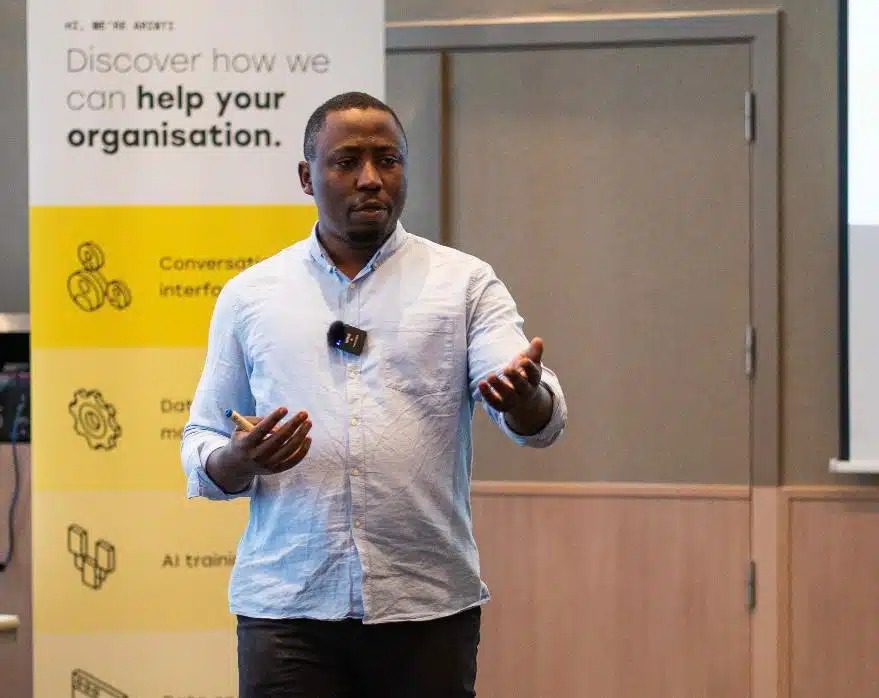
For Jehpte Ioudom, the journey into technology began with something very simple, having access to a computer at home while growing up in Douala, Cameroon. At the time, it felt more like curiosity and excitement than the beginning of a future career in artificial intelligence and data systems.
Everything changed during an internship at Ericsson Cameroon while he was still a university student. The company was dealing with challenges surrounding employee travel management, and Ioudom was assigned to assist with internal research aimed at understanding the difficulties staff members faced during official trips.
It was during that experience that he first discovered digital tools like Google Forms and Google Sheets through another intern connected to a Google student initiative. What appeared to be a simple survey project soon became a turning point in his life.
According to him, the ability to collect responses digitally and automatically organise large amounts of information opened his eyes to how technology could solve real business problems efficiently. Instead of manually sorting paperwork for weeks, he was able to gather and analyse information quickly for management decision making.
That moment changed his entire perspective about technology and data.
Although his academic background originally focused on management and business studies, his exposure at Ericsson gradually pushed him deeper into the world of technology. During the same internship, he also worked on projects linked to the rollout of 3G services for MTN Group, gaining firsthand experience in telecommunications infrastructure and digital connectivity.
After leaving Ericsson, Ioudom worked briefly in hardware and software sales before later joining Kia as a marketing and sales assistant in Cameroon. Despite being a commercial role, much of his work centred on research, customer behaviour, competitor analysis and market intelligence.
The deeper he became involved in analysing trends and business decisions, the more he realised how powerful data had become inside modern organisations.
His growing interest in technology eventually led him to Portugal, where he pursued a master’s degree in information management at Nova Information Management School. Coincidentally, his arrival also aligned with the relocation of Web Summit from Ireland to Lisbon, placing him directly inside one of Europe’s rapidly growing technology ecosystems.
While studying, he interned at an AI startup known as Define AI, where he worked on crowdsourced datasets used for artificial intelligence systems. He later joined Accenture and became more deeply involved in cloud systems, enterprise data projects and technology consulting during the peak of the COVID 19 era, when businesses across Europe were rapidly embracing cloud migration.
Rather than remain tied to a single company or industry, Ioudom decided to create his own consulting practice. In 2021, he officially launched Foubslabs, focusing on data engineering, analytics, cloud platforms and AI driven solutions.
Since then, he has worked with organisations across Africa and Europe in industries ranging from finance and pharmaceuticals to manufacturing, energy and public institutions. One of the projects he describes with pride involved collaborating with the World Bank on an artificial intelligence pilot programme for mathematics teachers in Benin Republic.
Technology, according to him, now shapes nearly every aspect of his life and work. From communication and business management to client relationships and research, digital tools have become central to his daily operations.
He explained that artificial intelligence has significantly transformed the way he works. Instead of manually handling every technical process alone, he now combines his own expertise with AI assisted systems for coding, brainstorming, client research and problem solving.
Among the platforms he relies on most are Anthropic’s Claude and LinkedIn, which he says has played a major role in connecting him to consulting opportunities, partnerships and clients.
To remain updated in the fast moving technology industry, Ioudom follows experts in AI, data and cloud systems across social platforms, attends conferences like Web Summit and maintains strong relationships with professionals working in different sectors.
He also credits online learning platforms, tutorials and digital communities for helping him build many of the technical skills he uses today.
Despite his enthusiasm for AI, he admitted that the growing cost of building advanced AI systems remains one of the biggest challenges facing developers and consultants in the field. According to him, the expenses involved in running large AI workflows and agents can increase very quickly.
Interestingly, one of the everyday technology frustrations he still hopes to see improved has nothing to do with artificial intelligence. He joked that the iPhone alarm system still feels unnecessarily stressful for someone constantly managing meetings, schedules and reminders.
Looking ahead, Ioudom believes the future of African technology will be shaped by two major developments, the spread of digital talent beyond major cities and the growing influence of artificial intelligence.
He explained that opportunities in tech are no longer limited to places like Lagos, Nairobi or Cape Town, as more Africans across different regions now have access to global learning resources and digital careers.
He also believes AI will dramatically reduce learning barriers, allowing more people to transition into technology and specialised industries much faster than before.
For him, that shift could become one of the most important transformations in Africa’s technology ecosystem over the next decade.