

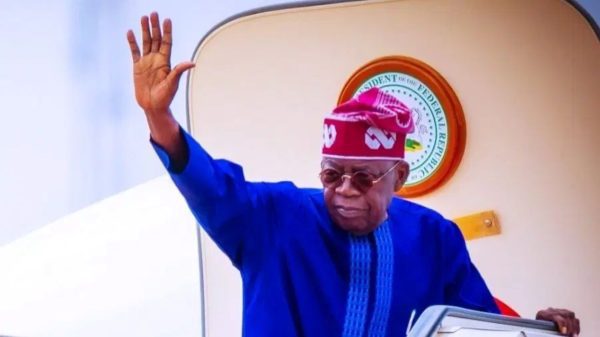


President Bola Tinubu’s frequent international engagements have become a focal point of national debate, as data shows the President spent 22 days of the first month of 2026 outside the country. With stops in France, the United Arab Emirates, and Türkiye, the President’s itinerary has sparked a wave of criticism from opposition parties and civil society groups, many of whom argue that his absence is ill-timed given the pressing domestic issues facing Nigeria.
The timeline of the President’s travels shows a busy start to the year. He spent the first ten days of January in Paris before heading to Abu Dhabi on January 11 for the Sustainability Week Summit. After a brief return to Nigeria on the 17th, he was in the country for less than ten days before jetting out again on January 26 for a state visit to Türkiye, finally returning to Abuja on January 31. This pattern of “governing from a distance” has led critics to question the government’s priorities, especially as sectors like education, security, and the national power grid continue to face significant strain.
During his visit to Abu Dhabi, Nigeria secured a Comprehensive Economic Partnership Agreement (CEPA), which the government says will remove tariffs on over 7,000 products for Nigerian exporters. Similarly, the trip to Türkiye resulted in various bilateral agreements covering defense, trade, and education. Supporters of the administration, including APC National Chairman Professor Nentawe Yilwatda, have described these trips as a “sacrifice” made in the national interest. Speaking on the matter, Yilwatda argued that the President’s global network allows him to achieve in a single day what might take others years to accomplish.
However, the opposition remains unconvinced. The Peoples Democratic Party (PDP) and the African Democratic Congress (ADC) have both called for more transparency regarding the cost and the necessity of these frequent departures. Mallam Bolaji Abdullahi of the ADC noted that Nigeria’s current challenges do not afford the luxury of a “visiting president,” suggesting that the administration is fueling unnecessary speculation by not being more open about the President’s extended stays in France.
Civil society leaders like Kolawole Omoniyi and Akibu Hamisu have also voiced their alarm. They pointed out that while international diplomacy is important, leadership should not be remote. They argued that many of these meetings could be handled by the Vice President or relevant ministers, allowing the President to remain on the ground to address the “existential problems” Nigerians face daily, such as rising food prices and the surge in kidnappings.
The 2023 Labour Party presidential candidate, Peter Obi, also joined the fray, criticizing the President for prioritizing international summits over the worsening security situation. Obi lamented that while the President was away, the country witnessed multiple grid collapses and a rise in abductions, even in the seat of power, Abuja. He suggested that the ruling party appears more interested in welcoming political defectors than in addressing the daily struggles of the Nigerian people.
As the President settles back into the capital, the pressure is mounting for the administration to prove that these foreign deals will translate into tangible benefits for the average citizen. For many, the true measure of these trips will not be the number of agreements signed, but the improvement in the security and economic stability of the nation.