





















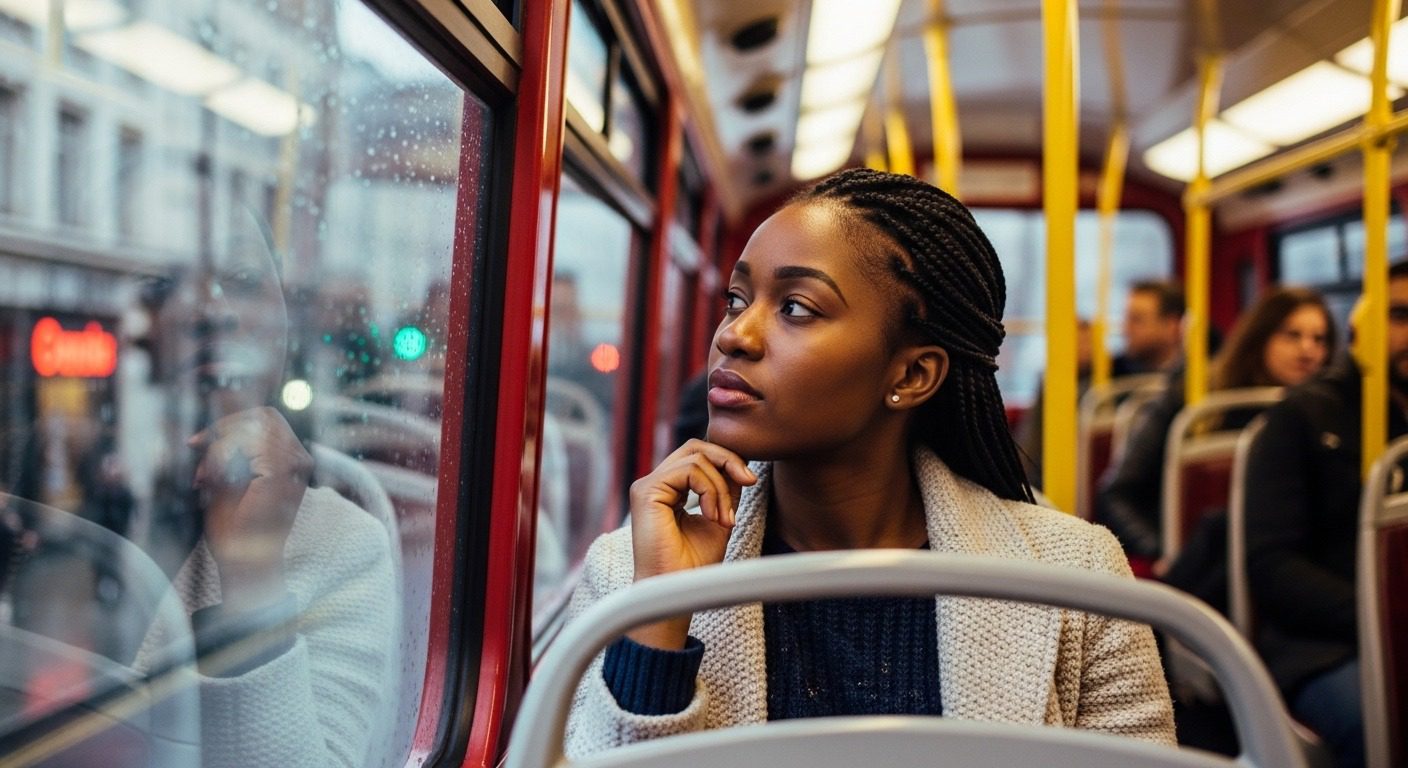
As the train station platform buzzed with the energy of fresh commuters, I looked up from our corner and caught sight of her. She was already settled in, but in a way that felt like a complete takeover. Sprawled across a row designed for three, she sat with her feet propped up on the communal chairs, lounging as if she were in her own living room. The influx of new passengers didn’t seem to register; she simply leaned forward, chatting loudly with friends across the aisle, seemingly indifferent to anyone left standing.
I couldn’t help but cringe. I found myself wondering, at what point does someone decide it’s okay to put their shoes on a shared public seat? For me, there is no level of cultural integration that will ever make that feel normal. It isn’t just a matter of “accepting people as they are” or “adapting to a new culture.” To me, it feels fundamentally wrong. I could almost hear my friend Chinwe back in Lagos teasing me about my “shoe police” tendencies, but the logic is simple: shoes go everywhere. They pick up grime, germs, and who knows what else from the street, only to be plunked onto a chair where someone else has to sit. It’s about basic etiquette, not just a culture shock.
“Here we go again,” Lantana chirped beside me, “the war of the savages and the barbarians.”
I snapped back, telling her to save it. I thought she was making excuses for the behavior, but she quickly clarified she was referencing Pocahontas—how invaders often view the locals as uncivilized while being quite “savage” themselves in their own habits. We eventually drifted into a deeper debate about the “shoe culture” we grew up with. In many parts of the world, especially across Africa, the Middle East, and Asia, the idea of bringing outside footwear into a clean space is a major taboo.
I tried explaining to Lantana that this isn’t just a “Nigerian thing” or something peculiar to the North. Whether it’s the Japanese Tatami or the Korean Ondol, many cultures prioritize the floor as a clean, sacred space for living and eating. Yet, here we were, watching someone treat a public chair like a footstool. It sparked a conversation about the value of a real education—the kind you don’t just get from a textbook, but from traveling and actually mingling with people outside your own bubble.
Lantana, ever the skeptic, pointed out that the girl on the train was technically “in her own house,” so to speak. “It’s their land, their rules,” she argued. “If you don’t like how they relax, maybe it’s time to pack your green passport and head back to Murtala Mohammed Airport.”
It was a sharp reminder of the immigrant’s dilemma. You carry your values and your sense of hygiene and etiquette with you, but you’re constantly navigating a world that doesn’t always share them. According to a recent perspective piece on Reports, social intelligence is about knowing when to adapt and when to hold onto your own standards of “common sense.” But at the end of the day, as I watched those shoes on the seat, I realized that some things like keeping your dirt off where others sit—should be universal, no matter which side of the border you’re on.