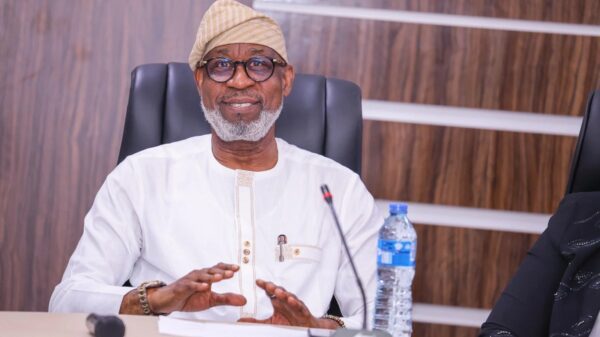

























Few appointments by President Bola Tinubu have generated as much intense interest and mixed reactions as the recent re-emergence of General Christopher G. Musa, the immediate past Chief of Defence Staff (CDS), now appointed as the Minister of Defence.
Just weeks ago, General Musa, an officer who enjoyed the overwhelming goodwill of Nigerians—estimated to be roughly nine out of every ten—was retired by the very same President. The rationale was ostensibly the “need to have more capable hands” at the helm. The irony was profound: Musa was one of the few military officers in recent memory to retire from the highest military post with thunderous public applause, suggesting his tenure had been largely successful. That overwhelming public goodwill sharply contrasted with President Tinubu’s decision that he was somehow not good enough to lead the military in such trying circumstances.
Now, the same President who deemed him unfit to command the defense assets has appointed him to oversee defense policy and coordinate all security and intelligence resources. One could logically conclude that President Tinubu is either poorly advised, possesses a highly fluid mind, or that the appointment is a highly calculated political move. Regardless, General Musa’s performance as Minister will ultimately determine whether he has been played as a political pawn or if he truly represents the dictum that you cannot block out the rising sun with your palm.
A Personality That Defies Typecasting
General Musa has, by deliberate effort or sheer fortune, cultivated a unique, likable personality that resonates even with groups often skeptical of his military profession or identity. His most outstanding posture is his persistent denial of being typecasted. He publicly identifies as a product of Sokoto while refusing to distance himself from his Atyap, Southern Kaduna origins. This refusal to fit the crude character molds Nigerians often create—such as being a Christian from the North who conducts himself as if faith holds no place in his relationships with all Nigerians—has served him well.
His public life is a study in defying the perceived links between one’s roots and one’s actions. His home state, Kaduna, has been severely ravaged by chronic ethno-religious conflicts, yet his personal disposition and relationships betray the notion that all citizens of the state carry massive chips on their shoulders or grudges that last for generations. He must have possessed exceptional qualities to ascend to the position of CDS in a military where character and competence alone often aren’t sufficient for the top-most post. Yet, his recent removal testifies to the inherent hazards of holding power at the very top.
Navigating the Minefield of Civilian Politics
This soldier, now thrown into the deep end of the civilian political terrain, faces a complex and unforgiving set of challenges. In fairness to President Tinubu, it must be acknowledged that Musa “jumped in while being pushed as well,” accepting the appointment. Every facet of his persona that previously served him well will now be subjected to intense critical scrutiny. His skills in military politics may not have saved him from being sacked while a former service chief he superintended was left in place, but now he must prove his mettle in the vicious, no-gloves world of raw politics.
Starting with his immediate past constituency, he must find a way to convince senior military officers—long accustomed to reading and adapting to political signals—that his sacking just weeks ago is not a stain that limits his influence over them. He must address the demoralizing practice of Service Chiefs bypassing the Minister to meet directly with the Commander-in-Chief. He must win several battles to restore the balance needed for a healthy, coordinated relationship between the C-in-C, the Ministry of Defence, the National Security Adviser, and the top echelons of the military, policing, and intelligence agencies.
The Golden Boy and the Political Traps
For a long time, the new Minister will have to contend with attributes that are conventionally unwelcome for a Minister of Defence, particularly given his background. He is now a civilian member of a government run by a party desperate to prove it deserves the trust of Nigerians. The government has already sounded the whistle for the 2027 race, where rampant insecurity will be the key determining factor for success or failure. This makes General Musa and the Ministry of Defence the administration’s “golden boy.
ing with non-state actors. He must quickly marshal enough power and resources to make a tangible difference in under one year. He will inevitably step on major political toes—those in political establishments supporting or opposing hardline approaches; a military widely rumored to be mired in corruption and collaboration with armed criminals; and a citizenry rapidly losing faith that the Nigerian state can protect them.
He must immediately address the Ministry of Defence’s legendary lack of transparency in procurement and financial mismanagement; find a way to productively engage with a Minister of State who lacks public confidence; and redesign strategies with powerful individuals like the National Security Adviser and the Villa circle. He must also overcome the challenge of a military high command that may view him merely as a civilian who warrants no more than a casual salute. Crucially, he must restore the pride and professionalism of a military whose image has been tarnished by continuous security failures and criticism from partners like the US.
The Politics of Identity
These challenges are significantly complicated by the fact that he has been dragged deep into Nigeria’s murky political terrain. He will inevitably be sold as a trophy by politicians hoping Tinubu’s future lies in ditching the Muslim North in favor of the Christian half. He will be a trophy for Kaduna State Governor Uba Sani, who has doggedly pursued a conciliatory, inclusive strategy in Southern Kaduna, radically different from that of his predecessor, El-Rufai.
Tinubu’s whispered strategy of shoring up his Northern support among non-Hausa/Fulani voters for 2027 will hope that this constituency recognizes and believes in his commitment to protect Northern Christians against being killed for their faith. Conversely, circles of Muslim influence will likely interpret this appointment as evidence that Tinubu is whittling down their faith’s influence in his administration, reinforcing the rumored certainty of a Muslim-Christian ticket in 2027.
Ultimately, the majority of Nigerians will simply hope that this appointment triggers a major reversal in what appears to be the Nigerian state’s losing streak against those who kill citizens with impunity. General Musa has taken on his toughest fight yet. Individuals have made huge differences in the lives of people; let us hope General Musa will prove to be one of them.