



















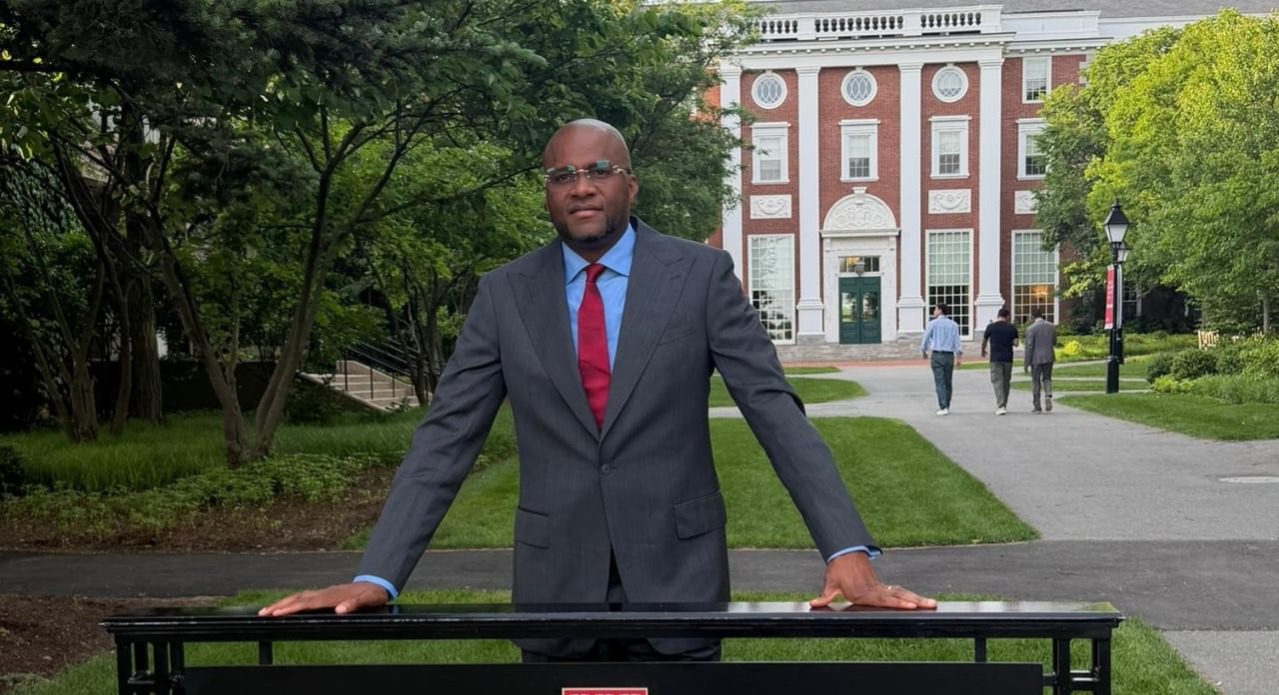
Nigerian entrepreneur and philanthropist, Chimaobi Desmond Anyaso, who is also the Labour Party candidate for Bende Federal Constituency in the 2027 House of Representatives election, has called for a renewed focus on trust and institutional strength as the foundation for Africa’s long term development.
He made the remarks while speaking as a panelist at the 10th anniversary conference of the IFE Institute of Advanced Studies held at Harvard University. The gathering brought together scholars, policymakers, business leaders and members of the African diaspora under the theme “Building Lasting Institutions: Faith, Scholarship, and the African Project.”
During a session focused on leadership, governance and institutional trust, Anyaso said Africa’s progress will depend less on individual brilliance and more on the ability to build systems that remain strong beyond any single leader. He noted that many of the continent’s governance challenges are rooted in a growing trust gap between citizens and public institutions.
According to him, trust remains the most important factor in effective leadership and governance. He explained that when trust exists, institutions function smoothly, but when it breaks down, even well structured systems begin to weaken.
He added that public confidence plays a direct role in how societies function, stressing that citizens comply with laws more willingly when they trust the institutions that enforce them. He also noted that investors commit resources more confidently in stable environments, while young people remain hopeful when governance systems are credible.
Anyaso cautioned that leadership must be anchored on integrity, empathy and accountability, warning that society suffers when ethical individuals avoid public service. He described leadership not as privilege, but as responsibility and service to others.
Reflecting on his personal journey from business and philanthropy into politics, he said leadership should always be seen as a duty rather than a position of power. He also referenced his roots in Abia State and commended ongoing governance efforts in the state under current leadership.
He expressed appreciation to the founder of the IFE Institute of Advanced Studies, Jacob Olupona, for creating a platform that encourages global dialogue on governance, faith and institutional development.
A major point in his message was that Africa’s challenge is not a shortage of capable individuals, but the inability to build strong institutions that can outlast leadership transitions. He noted that the continent has no shortage of talent, but needs systems that can convert individual excellence into lasting institutional performance.
He explained that sustainable development cannot rely on personality driven leadership alone, but must be supported by structures that promote accountability, continuity and merit based systems. He compared this to the private sector, where organisations that depend solely on founders rarely survive beyond a generation unless strong systems are in place.
He urged African governments to deepen transparency, strengthen respect for the rule of law and ensure that public appointments are based on merit. According to him, the legitimacy of any institution is ultimately determined by the trust it enjoys from the people, not just its legal foundation.
Anyaso also highlighted the importance of faith based institutions and universities in shaping ethical leadership, noting that governance without moral grounding risks losing direction. He described leadership without character as power without purpose, adding that public office should be viewed as stewardship.
Speaking on development priorities, he called for greater investment in education, youth empowerment, technology and entrepreneurship. He described Africa’s young population as its greatest advantage if properly developed and supported.
He also pointed to the African diaspora as a key partner in development, describing it as a bridge between local potential and global opportunity. In addition, he emphasized that countries which invest in knowledge production and research are more likely to shape the future global economy.
In his closing remarks, Anyaso called for stronger collaboration among governments, private sector leaders, academics and faith based institutions to build systems that can endure across generations. He stressed that Africa’s future will depend on its ability to create institutions that inspire trust and deliver consistent results.
He left participants with a final reflection that drew strong attention: strong individuals may shape moments, but it is strong institutions that build civilizations.