

































Emergency responders in Lagos are undergoing a high-tech transformation as virtual reality begins to replace traditional classroom settings. More than 300 professionals have already donned VR goggles to participate in immersive simulations, such as responding to life-threatening accidents on the Lekki-Ikoyi link bridge. This technology allows trainees to apply critical life-saving skills in real-time within a controlled, digital environment.
Tunde Rotimi, who oversees Strategy and Innovation at MacTay, believes the true value of this approach lies in the ability to repeat high-stakes scenarios without any actual risk. He points out that recreating a major fire or a multi-car pileup in the real world is both dangerous and financially impractical. By modeling the Lekki-Ikoyi bridge virtually, the program can train hundreds of people simultaneously—something that would be a logistical nightmare on the actual bridge.
This initiative is part of a broader shift for MacTay, a firm with over 40 years of history in HR consulting that is now rebranding itself as a technology-first organization. The company is moving beyond simply using gadgets to stay trendy; they are now building specialized AI and VR tools designed to enhance human performance rather than replace it. This mission has led to close partnerships with the Lagos State government, specifically within the healthcare and education sectors.
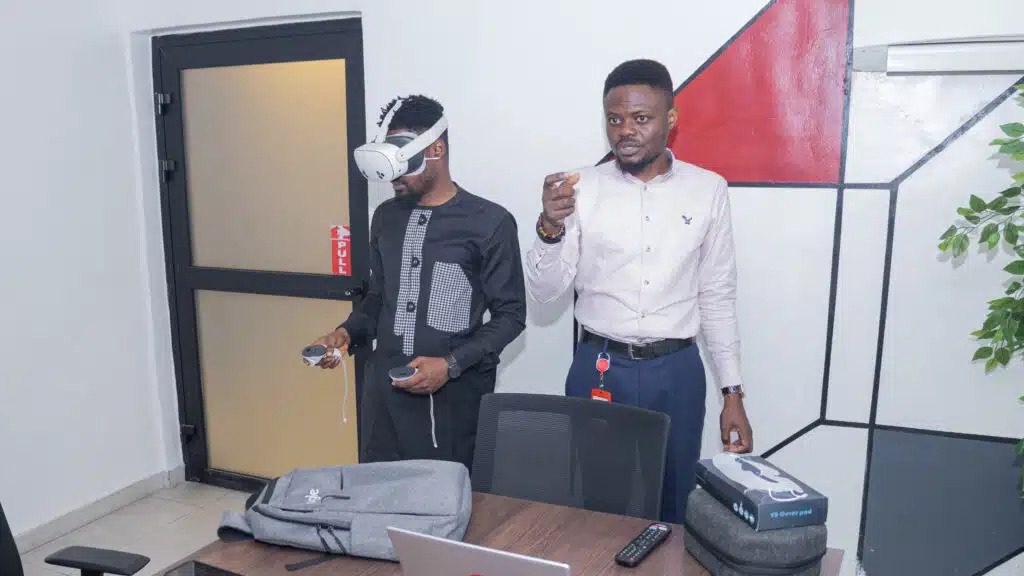
The VR program used by the Lagos State Ambulance Service (LASAMBUS) actually had an unexpected beginning. Initially, the technology was designed to help students in Lagos schools visualize complex STEM concepts, like human anatomy or microchip architecture. However, after discussions with the Ministry of Health, the team realized the same immersive tools could be repurposed to save lives. In the current simulation, trainees find themselves at a motorcycle accident scene where they must use handheld controllers to check pulses, administer first aid, and coordinate with incoming ambulances. The haptic feedback and real-time prompts force them to make the kind of split-second decisions required in the field.
While many still view virtual reality as a tool for gaming, its application in professional training is a proven global trend. Leading institutions like Johns Hopkins and the Mayo Clinic have long used it for surgical prep, while construction and military organizations rely on it for safety drills. In Nigeria, despite a period of slow adoption between 2016 and 2019, startups are beginning to push the boundaries of what is possible with augmented and virtual reality.
Looking ahead, the goal is to expand these immersive solutions into basic and higher education across the state. By making learning more engaging and training more accessible, MacTay hopes to build capacity at a scale that was previously impossible. If the success in Lagos continues, this model could eventually serve as a blueprint for immersive professional training across Nigeria and the wider African continent, proving that technology can solve local problems while building world-class expertise.