
















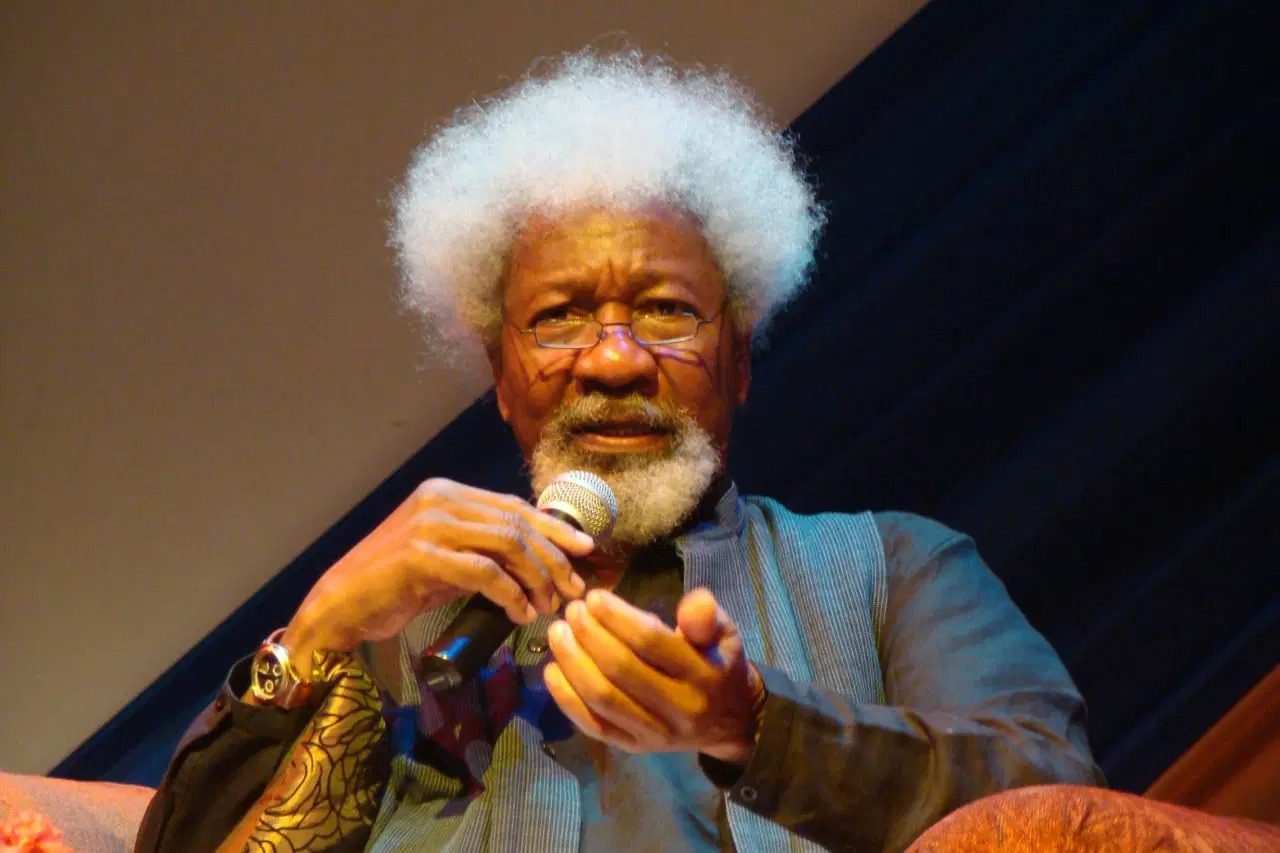
Nobel laureate Wole Soyinka has taken aim at what he considers an excessive show of force around the family of President Bola Tinubu, warning that the scale of security deployed to protect them raises troubling questions about national security priorities. He made his concerns known at the twentieth Wole Soyinka Centre for Investigative Journalism Awards in Lagos on Tuesday, where he recounted a recent encounter that left him stunned.
Soyinka explained that he had been leaving his Ikoyi hotel when he walked into what he initially believed was the set of an action film. He said the number of heavily armed operatives stationed across the hotel grounds was so large that he mistook them for actors. A young man later approached and greeted him politely, and only after making inquiries did Soyinka realise the security escort belonged to the president’s son.
He said the detail consisted of about fifteen heavily armed officers, an arrangement he considered extreme. The sight, he added, looked more like the presence of a small battalion capable of taking over a neighbouring city such as Benin Republic. Disturbed by what he saw, Soyinka said he immediately attempted to reach the National Security Adviser to confirm whether the deployment was officially sanctioned.
According to him, he eventually managed to speak with the NSA, who was in Paris at the time. Soyinka said he questioned why the son of a head of state would move around with such a large and heavily armed team, insisting that he found it difficult to accept as normal.
Speaking with a mix of frustration and irony, he remarked that with such a formidable force attached to one individual, the government might not need to send the military or air force to quell any disturbance in neighbouring countries. In his words, the president could simply ask his son to handle such matters since he already moves with what looks like a full unit.
Soyinka added that while it is natural for leaders to have families, the privileges that come with public office must never be stretched beyond reason. He warned that assigning such an extensive security presence to someone who holds no public position distorts the security structure of the nation.
He reminded the audience that children of national leaders should understand their roles and never assume the status of figures of authority. His remarks come at a time when Nigerians continue to debate the growing visibility of state security around politically connected individuals, especially in an era marked by widespread insecurity across the country.