


























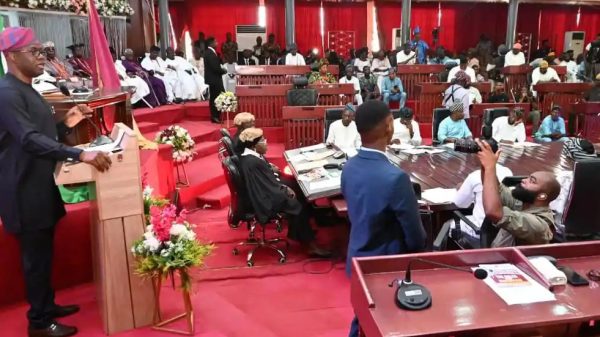











The Minister of the Federal Capital Territory, Nyesom Wike, has launched the construction of three new magistrate courts in Abuja, signaling a renewed push to strengthen the justice system with modern facilities and better working conditions for judicial officers.
The projects, which will be sited in Jabi, Asokoro, and Garki, are part of President Bola Ahmed Tinubu’s Renewed Hope Agenda that prioritizes access to justice, housing, and improved welfare for judges and magistrates. Wike emphasized that quick and fair dispensation of justice cannot thrive without providing the right environment for the judiciary to function effectively.
Speaking at the flag-off, he credited the initiative to President Tinubu’s vision, recalling the President’s consistent message that the fight against corruption and delays in justice delivery must be anchored on supporting judicial officers with adequate infrastructure and welfare.
Wike described the condition of some existing courtrooms as “embarrassing” and unsuitable for judicial work. He assured that by the end of President Tinubu’s first term, a large portion of the accommodation challenges facing judicial officers would be resolved. According to him, 20 duplexes will be handed over to the FCT High Court by October, with another 30 scheduled for delivery next year as part of ongoing housing projects for magistrates and judges.
The Minister noted that beyond infrastructure, the government is also focused on ensuring the judiciary gets sustained support under the Renewed Hope Agenda. “We cannot demand efficiency and fairness from the courts without first creating an environment that enables them to perform,” he said.
Providing further details, the Executive Secretary of the Federal Capital Development Authority, Engr. Yonana Dauda, revealed that the Jabi Magistrate Court will be a modern complex equipped with courtrooms, magistrates’ chambers, a conference room, a library, office spaces, and other support facilities. He explained that the initiative will ease congestion in existing courts, improve access to justice across the FCT, and create employment during construction.