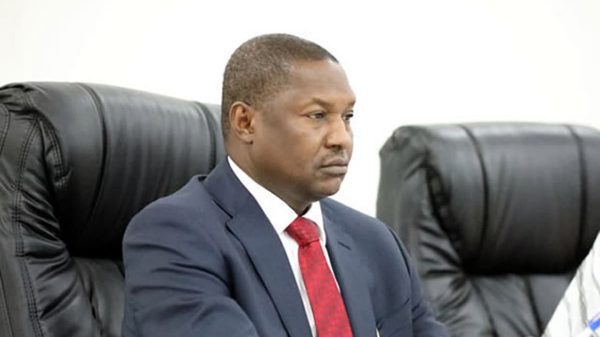






























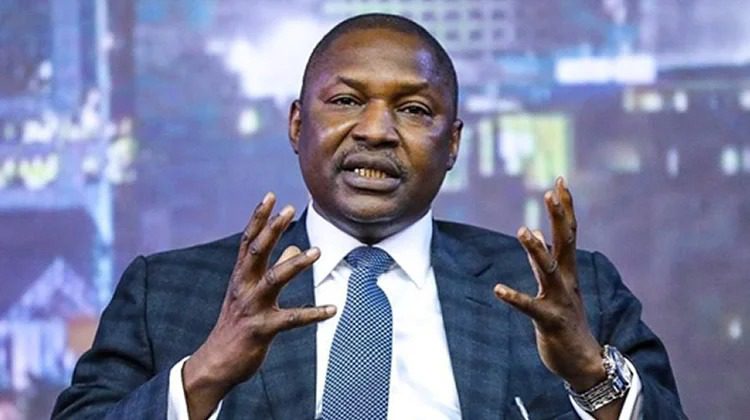
Former Attorney-General and Minister of Justice, Abubakar Malami, SAN, has firmly rejected claims linking him to terrorism financing, describing them as baseless, misleading, and politically motivated.
In a statement released on Friday, Malami addressed a publication that suggested he and others had connections with individuals described as terror suspects or alleged financiers. He characterized the allegations as unfounded and unfair, insisting they contradict both his public record and objective facts.
Malami stressed that he has never been accused, summoned, interrogated, or investigated by any security, law-enforcement, or intelligence agency, in Nigeria or abroad, for terrorism financing or related offences. “I state clearly and unequivocally that at no time have I faced any accusation or investigation on terrorism financing,” he said.
He also pointed out that the retired military officer cited as the main source in the publication had explicitly clarified that he was not accusing Malami or the other individuals of financing terrorism. According to Malami, this critical nuance was lost in sensational headlines, which he argued were exploited by political opponents to create misleading insinuations.
“Terrorism financing is a grave crime with severe consequences for national security and human life. Associating anyone with such an offence requires verifiable evidence, lawful findings, and due process, not conjecture or guilt by association,” he emphasized. Malami argued that professional or institutional interactions should never be misinterpreted as proof of wrongdoing, pointing to his record in office as a clear contradiction to any suggestion of complicity.
He highlighted major reforms he championed as Attorney-General, including the creation of the independent Nigerian Financial Intelligence Unit, the enactment of the Money Laundering (Prevention and Prohibition) Act 2022, and the Terrorism (Prevention and Prohibition) Act 2022. These measures, he noted, strengthened collaboration between agencies like the NFIU, the Central Bank of Nigeria, and law-enforcement bodies, contributing to Nigeria’s removal from the Financial Action Task Force grey list.
Malami underscored that engaging with a broad range of individuals is a normal part of public service and should not be misconstrued as evidence of wrongdoing. He urged the media to report responsibly on national security matters, warning that careless coverage can damage reputations and erode public confidence in state institutions.
He reaffirmed his commitment to the rule of law and Nigeria’s international obligations, stressing that he reserves the right to seek redress against any publication that misrepresents his role in combating money laundering and terrorism financing.